Why Pigeons Keep Coming Back After Pigeon Exclusion
Pigeons still hanging around after removal? Learn how mesh, spikes, and other deterrents work and what you should realistically expect over the first month.
Why Are Pigeons Still Hanging Around After Removal?
We recently got a call from a customer — let’s call him Tom — who had us out for pigeon removal a little over a month ago. We’d installed mesh “cages” to block off the eaves where the pigeons were nesting, cleaned everything up, and explained that it could take a few weeks for the birds to fully move on.
A few weeks later, Tom called back and said, “The mesh is still intact, they’re not getting inside anymore, but the pigeons are still hanging around on the ledge. Shouldn’t they be gone by now?”
If you’ve invested in pigeon removal and you’re still seeing birds on your roof or eaves, you’re not alone. Let me walk you through what’s happening, how the deterrents really work, and what you should reasonably expect after a pigeon service.
What Pigeon Exclusion Actually Does (And Doesn’t) Do
When we talk about “pigeon removal,” what we’re really doing is exclusion and deterrence. That means:
- Blocking off nesting and roosting spots (like eaves, ledges, and roof valleys)
- Cleaning up droppings and nesting material so the area is sanitary again
- Making the space uncomfortable so pigeons choose to go elsewhere over time
What it doesn’t mean is that pigeons instantly vanish from your property the moment we finish the job. Pigeons are creatures of habit; they’ve often been using those eaves or ledges for months or years. Even after we block access, they’ll come back for a while to investigate and see if their old home is still available.
In Tom’s case, the mesh cages were doing their job: the birds couldn’t get into the eaves anymore. But they were still loitering nearby on the edges and gutters, trying to figure out a new routine.
How Mesh, Screens, and “Wire Boxes” Work
For many homes, especially those with open Spanish tiles or open eaves, we use mesh screening or what some folks describe as “wire boxes.” These are rigid mesh panels custom-fitted to seal off the gaps under your roofline.
Mesh does a few important things:
- Blocks access to prime nesting spots where pigeons like to tuck in and feel safe
- Prevents new nests from being built inside the eaves
- Stops droppings and feathers from accumulating in those hidden areas
Once the mesh is in place, pigeons may stand or walk around near it, but they can’t get back into their favorite cavities. That’s why you might still see them “hanging outside the boxes,” just like Tom described to us.
Over time, as they realize there’s no longer safe nesting or roosting space, most flocks will gradually relocate to a more accessible structure nearby.
When We Add Spikes (And Why)
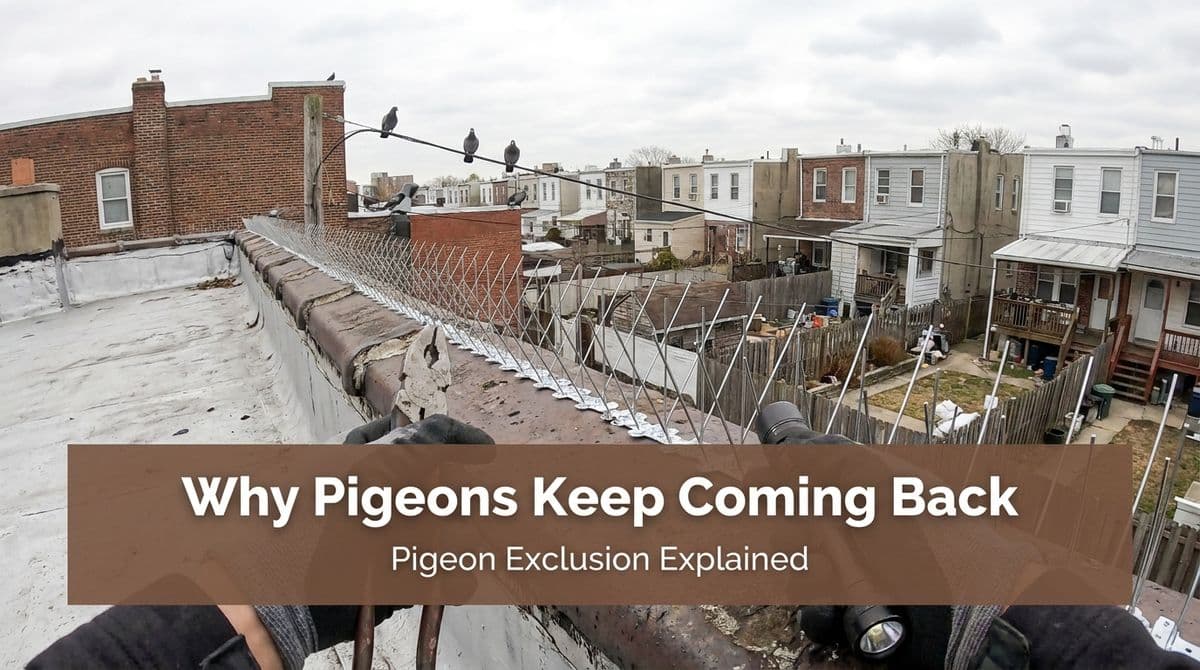
In Tom’s situation, after reviewing photos and our notes, we recommended adding pigeon spikes on the ledges directly in front of the mesh. This is a common next step when pigeons keep loafing right next to the exclusion work.
Here’s how spikes help:
- They make flat surfaces uncomfortable for pigeons to land and rest on.
- They reduce perching in front of blocked eaves and under overhangs.
- They encourage birds to move on faster because there’s nowhere stable to sit.
Properly installed spikes don’t hurt the birds; they just take away the easy, comfortable perching spots that keep pigeons hanging around your roof.
How Long Should It Take for Pigeons to Leave?
This is one of the most common questions we get, and it came up with Tom as well. Here’s what we usually tell homeowners:
- First 1–2 weeks: Expect pigeons to return repeatedly, circling and landing as they test the new barriers.
- Weeks 3–4: Activity typically starts to taper off as birds realize they can’t access their old nesting spots.
- After a month or so: Many flocks will have mostly moved on, though you may still see the occasional visitor or transient bird.
If it’s been a month or more and the birds are still spending a lot of time on your roof, that’s usually when we talk about adding supplementary deterrents, like spikes or optical gels, or checking for any new gaps they might have found.
What Homeowners Should Expect From a Pigeon Service
When we do a pigeon job, we try to set clear expectations up front so there are no surprises later. Here’s what you should expect from a professional service like ours:
- Thorough inspection: Identifying all active and potential nesting/roosting areas.
- Sanitary cleanup: Removing droppings, nests, and debris, and treating as needed.
- Exclusion work: Installing mesh, screening, or netting to close off access.
- Follow-up options: Spikes or other deterrents if pigeons keep perching nearby.
- Clear warranty terms: Knowing what’s covered (for example, screening on eaves) and for how long.
With Tom, the initial work was focused on cleanup and screening the eaves, with a limited warranty on that screening. When the pigeons kept hanging out, we were able to talk through his options for adding spikes to finish the job and speed up the birds’ departure from his roofline.
Simple Things You Can Do to Help Keep Pigeons Away
There are also a few things homeowners can do to support the exclusion work and make your property less attractive to pigeons overall:
- Remove food sources: Avoid feeding birds, secure trash, and clean up around outdoor eating areas.
- Rinse fresh droppings: Spray down patios and railings so pigeons don’t “mark” the spot.
- Monitor for new activity: If you spot birds trying a new corner or gap, let us know early.
- Trim overgrown trees: Reduce easy launching and landing spots close to your roof.
Exclusion is a partnership between the work we do on your home and the way the property is maintained afterward. Together, we can make your place a lot less attractive to pigeons in the long run.
Still Seeing Pigeons After a Service?
If you’ve had pigeon work done and you’re worried because the birds are still hanging around, it doesn’t always mean the job “failed.” It may just be that the pigeons are in that adjustment period, or that a second layer of deterrents — like spikes in front of mesh — is needed to finish the job.
If you’re unsure what’s normal or you’d like us to take another look, we’re always happy to come back out, review the work, and talk through your options. Our goal is the same as yours: a cleaner, quieter home without pigeons taking over your roof.